Showing posts with label words. Show all posts

Saturday, April 4, 2020

A Beginner's Guide to Copyediting | Part Two

In the last part of this series, we talked about the general parameters of copyediting as a job, style guides, and a little bit on freelancing. If you haven't read that part, check it out here: A Beginner's Guide to Copyediting | Part One

This time, we're going to talk about copyediting marks and when/how to query an author during copyediting. This post is a lot more practical in its application, and these are the skills that you'll be using to actually edit.

Now, it must be said, copyediting marks are only used if the publishing house you're working for still edits with physical manuscripts. If it is digital, there will be other protocols for editing that can include anything from using track changes on Microsoft Word, using the commenting feature on Adobe Acrobat, and commenting or suggesting on Google Docs. That will be specified by the house upon hiring, and when doing that, you just make the necessary changes using the specified tool. Any time you want to query, you'll just add it as a comment.
This displays track changes in Microsoft Word.

So what is querying? Querying is an important part of copyediting, because it is communicating through worded comments rather than copyediting marks that typically concern things like tone, voice, logic, or fact versus fable.

Let's break that down a little bit further. Say you're reading a piece that is written conversationally for a magazine that has a light tone and talks about culture and entertainment in real-time. Everything is in line, and then there is a sentence with high vocabulary and cultural theory that sounds stilted compared to the rest of the piece. In that situation, you might have ideas of words and expressions that would better communicate the meaning of the sentence without affecting the tone. But, your job is to edit, not to write the article, so rather than making the change with copyediting marks, you would query something along the lines of "These ideas come across as a little bit elevated as is. Perhaps use the words..." and then insert your suggestion.

It's important that you explain why you think it might be a problem, and it's also important that you phrase your query in a way that makes it seem collaborative rather than harsh. An author who feels that their work is being attacked won't react well, and that could lead to them complaining to your employer, making business harder, or simply rejecting the edits because of wounded egos. This is never an easy line to toe, however it is a really important thing to be aware of.

Beyond tone or vocabulary, you'll typically want to query something that reads as illogical. This would be working more on a novel where there is supposed to be a logic to the world, plot, etc. or on a more academic piece. If a conclusion is made, or something happens that doesn't follow the logic of the rest of the piece, it is your job to point that out.

A query on something like this would be a little bit more questioning in nature. You can add suggestions of what you think would make more sense, but your main objective here would be to ask the author the questions you have about the logic. When going through and approving edits, they can read where the confusion is and make the necessary changes, or add a sentence substantiating the jump in logic. Either way, this is very important for author credibility.

Sometimes when fact checking, something is undeniable (like the date that a world war started). Other times, however, there are things that you cannot corroborate with your information like the spelling of a person's name or a description of an old town. You'll need to query this outright rather to bring it to the attention of the author.

Here, the key is to not overdo it. If you know for a fact something is wrong, simply change it with a deletion mark and a caret. Only query when you suspect something is incorrect, or you tried and cannot find the information online.

For any of the queries, the comment should be written with the mark "Q:" or "Qu:" preceding the comment in the margins of the text. This looks the same digitally and in print.

Now, for the rest of copyediting marks, what do they look like?

Here's a handy sheet:
These are pretty standard across the publishing industry. You'll use these within the actual text to communicate what needs to change. If the author approves these edits, these marks will be sent to a typesetter to make the necessary changes, so it's imperative that they're accurate and very clearly written.

The only thing that won't go directly in the text is something like "stet," which as you see is circled. Any word/abbreviation that is written out and circled goes in the margin next to the line where the change is being made.

To indicate what copyedit you are reversing, you would just put ..... under the word that was edited with the "stet" in the margin.

What I want to end this post with is a reiteration of my earlier point about how to address the author. In any query, email, or author letter in which you are making changes, you have to keep the tone cordial and respectful.

But you also have to ensure that it doesn't become overly reverent. You can compliment where things are done very well, but your job is not to boost the author's ego. Do not shower them in compliments, or try to be overly nice before you make an edit so that it is received well. Simply ensure that you are suggesting and being collaborative.

In other words, you don't want to say, "This word makes you sound pretentious, change it," but you also don't want to go too far the other way with something like: "You're vocabulary is stunning and it's so impressive how smart you are, but I think here a different word could work."

You want the sweet spot in between there. Something closer to: "As is, the sentence makes sense, but to keep the tone of the magazine and the piece, you might want to consider using a different word such as..."

That way, you are being respectful, but still getting your change across without going too far in either direction.

All of this being said, this is the true meat and potatoes of copyediting. What you'll spend most of your time doing is using these marks and queries to make the changes, and sometimes you'll compile a letter after the fact detailing what you did and some larger changes that the author could consider making that you didn't mark.

Being well-versed in these marks and in this communicative style is imperative for any successful copyeditor.

In the next part of this series, I'll dive into proofreading, some of the trickier grammatical topics such as who/whom, number formatting with different style manuals, and how to make your own personal style sheets. It will be out Monday, April 6, 2020 at noon!

Make sure to leave a comment if you have any further questions, I'm always around to help!

Wednesday, December 19, 2018

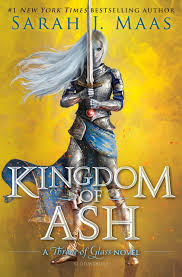
"Kingdom Of Ash" | Sarah J. Maas

I'm writing this review far in hindsight, so some of the details might be vague and some of the feelings muddled, but boy do I have a lot to say about this novel.

"Kingdom of Ash" is the seventh and final novel in Sarah J. Maas' popular "Throne of Glass" series, and it tells the story of Aelin and her friends as they embark in the final war against the dark forces that threatened them and their world. I won't go into much more detail, for it would get far too complex and take up the entire page just trying to explain each and every plotline.

Going into this, I was a little bit wary, as I liked A Court of War and Ruin—the only other novel we have from Maas that ended a series, but I found myself with lingering dissatisfaction when I thought of the novel. I wasn't sure how she would end this series, but I was unsure if she could do it well; everything seemed so scattered, too many loose ends flailing too far from one another, and her track record not incredible in my opinion.

To say I was pleasantly surprised is an understatement.

On the whole, I was very happy with this novel. Despite being nearly a whopping 1,000 pages, I didn't feel like I was drowning in pagecount while I read the novel, and between following Aelin's terrible journey in the hands of Maeve, to seeing reunions of characters who'd been long separated, to watching the epic final battle, I felt engrossed for the most of the time.

To keep it simple, I was satisfied with the loose ends Maas tied up, the ending a tear-jerker, though a bit dragged out if you ask me. A good chunk of the novel was dedicated to the final battle, which I really appreciated (particularly as a reader who has read too many novels that shove the climactic scenes into thirty pages and call it a day), and some of the revelations made in this novel tied back to details laid out early in the series, which I adored.

However, I think the truth of it is, Maas was juggling a few too many point of views and storylines. Though I think she did the best she could, and don't get me wrong, her writing was good in this novel, however we were split into so many points of view across so many parts of the world that I found myself confused or at times wondering about other characters. We had Aelin being locked away with Maeve and Rowan on his search through the continents to find her, Aedion and Lysandra fighting battles away from the rest of the characters, Yrene and Chaol sailing back from the Southern continent and then returning to Chaol's home, Dorian and the Thirteen hunting for the Crochan witches, and that is just a summary, leaving out a lot of other main characters who had perspectives in the same settings as some of the above listed. Any author, no matter how skilled, would have trouble juggling so many different settings and characters and storylines, and the thing I think I felt the most while reading this novel was wonder about the other character's whereabouts.

Though I loved the scene where they all met in the end, it felt tiring at times to switch to another point of view in another setting and try to remember what had been happening with them. There were times where I felt confused about who was where, or lacking backstory or depth to some of the short snippets we got. And those shortcomings are inevitable with any novel trying to deal with so many different storylines at once, however it was frustrating to get brief glimpses of Chaol and Yrene—who I had grown to love after "Tower of Dawn"—interspersed, or to get a random point of view from Lysandra that didn't seem to contribute too much, where I spent more time trying to remember where and who she and the army were fighting than I did paying attention to what was happening.

All of that being said, I do think the character arcs in this novel were done brilliantly, and I found myself barely resenting Aelin and Rowan, a big step up from where I left on in Empire of Storms. Their love felt more deep, their bond feeling realistic and mature in this novel, a big step outside of what they'd been in past installments. Watching Dorian grow as a character, develop a willingness to sacrifice himself for his people and his country, and grow into the King he was meant to be was a pleasure, and Maas wielded him beautifully. The scenes in Morath with him were perfect, just what I needed leading up to his reunion with the rest of the characters and the final battle.

Reading the scene where the Thirteen sacrifice themselves was absolutely heart-shattering, the description of the loss Manon felt after that and the pain that the whole army seemed to suffer in awe of their death was done so well I practically felt like I lost people myself.

There were so many moments of this novel that were beautiful, Maas flowery writing shining through with a couple lines that I know will stay with me for a long time.

And at its heart, this is a novel about dreamers, people willing to fight tooth and blood and sacrifice themselves for these dreams, for a world that was better than the one they'd been born into. And at its heart, I think I could never hate a book with those themes because they resonate so deeply with me.

To end this review, I'll leave you with a quote that embodies what I just described.

"There's a better world out there, and I have seen it."


~~


Characters: 85%
Plot: 90%
Depth: 85%
Style: 90%
Intrigue: 95%
Overall Rating: B+

Monday, October 22, 2018

The Power of Words

As someone who spends a lot of their time immersed in the world of words, sometimes I lose a grip on why I love it so much. It's not that I lose hope in words, or that I fall out of love with language, it's that I become so blind to what I'm doing and so exhausted from constant work, that sometimes I forget about the spark that ignites in me whenever I read or write.

Now, from being in this community for a long time, I know that's not particularly uncommon. And frankly, we all need breaks from things we do a lot, even if we love them. Hence reading slumps, writer's block, etc. But sometimes, after long months of being uninspired, in rare moments when the cosmos seem to bleed together and brew the perfect moment, you're reminded just of why words are so powerful.

For me this happened a few weeks ago. It was a grey day, the first chill of autumn creeping into the air. I'd been slowly chugging my way through "Big Magic" by Elizabeth Gilbert, and on this day I was possessed by an inexplicable desire to devour it. So I sat down in a free hour I had and sped through the ending of the book. Upon finishing it, my eyes were wide, my heart was pounding, and every thought of mine was refocused back to writing.

It had been a long time since I'd been so inspired. Her writing is beautiful, of course, and her metaphors are masterful, but she also has that magic that she writes about. Her words carry with them a preternatural ability to move you, to get you out of your worries and fears and onto the computer to get writing, or acting, or whatever it is you love and want to pursue.

As she urged the reader, "So please calm down now and get back to work, okay? The treasures that are hidden inside you are hoping you will say yes," I felt electric, like I'd been struck with the brilliance and the magic of the world upon which us writers and readers operate.

But I couldn't sit and stew on this moment. I couldn't revel in the energy that coursed through me, or jump on the train of adrenaline that was making my fingers itch to write. I'd bought tickets to see Porsha Olayiwola perform "Black and Ugly As Ever," and it was time for me to leave.

So, still radiating the creativity that Gilbert had instilled, I hopped on the train and shot over to see Olayiwola's performance. And needless to say, it was incredible. As she whisked us through her life, her experiences, and the flaws in our culture, I felt that energy in me heightening. It didn't fizzle, or drain out as sometimes happens when you let it sit. Instead, it grew, multiplying and spawning something I hadn't felt in a long time.

As Olayiwola stood before a crammed club and bellowed, "I'm so black I'm not alive, just not buried yet" and "Every time I twirled my afro out, I knew I was some kind of rebellion," I felt the energy in the room crackling.

My world was flowing and ebbing, the fibers of my brain coming undone and forging themselves anew. See, it is rare moments like that where the power of words becomes so apparent, so intense that it overwhelms you, that it seems to beat in every breath in the sweaty room, seems to twine with the stars and sing in the streets. It is not every day that you feel so intensely, so powerfully about how much words mean and the command they hold. Experiences like those are fleeting, blessings in a way. And I couldn't be more grateful.

You see, I was in a slump, dawdling in an unmotivated state. I hadn't written in weeks, I was barely getting through novels. I felt like I was drowning in work, and the world was starting to look more and more bland.

But words are more powerful than that. They are sometimes wretched and cruel, but they are powerful. And when you need them most, they sweep through and remind you just why you love them so much.

So if you are in the position I was in just a few weeks ago—feeling uninspired, not good enough, lost, or dazed—then let this be my beckon to you. Re-immerse yourself in the world of words. Don't give up, don't lose yourself now.

Keep chipping away at that novel you're reading, write a little bit every day, even if you have to gut the words out of yourself. Because I promise, you'll get your moment as well. You won't be uninspired forever.

As long as you keep trying, inspiration will strike again, and you'll remember awe-inspiring power of words for whatever reason it was.

And once they do, you'll be unstoppable.